New paper: A damage–healing finite-strain Cam-Clay model for hard-packed snow
Our paper, co-authored with Prof. Michael Kaliske at TU Dreden, on a damage–healing finite-strain Cam-Clay model for hard-packed snow has been published in Computer Methods for Applied Mechanics and Engineering.
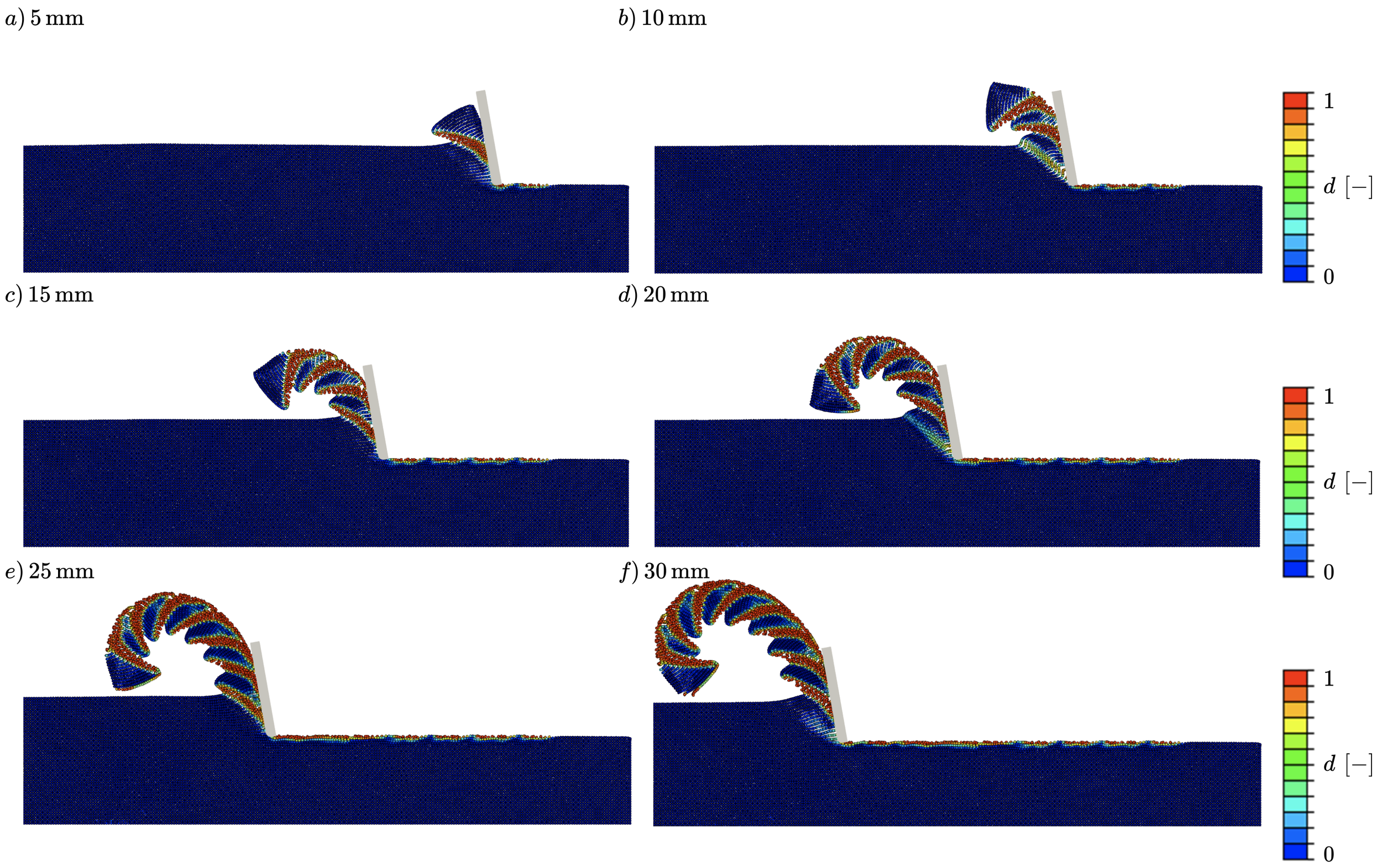
Abstract: Reliable prediction of mechanical interactions with hard-packed snow requires constitutive models that capture coupled plasticity, damage, healing, and large deformation. Current constitutive formulations for snow typically neglect either damage-induced degradation or stiffness recovery (healing), particularly under finite-strain conditions relevant to high-speed interactions such as tire-snow contact. While continuum damage-healing models exist for materials such as concrete, asphalt, and polymers, their direct application to snow is hindered by snow’s distinct rapid mechanical degradation and healing behaviour. In this contribution, a finite-strain constitutive model is proposed for hard-packed snow, incorporating both damage and healing effects. The elastic response is described by a Neo-Hookean constitutive law, while plastic deformation is governed by a cohesive extension of Modified Cam-Clay plasticity augmented with exponential hardening. Damage evolution is driven by deviatoric plastic deformation, whereas healing is activated by compressive volumetric plastic deformation. The finite element method (FEM) is used, and mesh objectivity is maintained through a non-local regularization approach. Model parameters are calibrated using numerical triaxial and uniaxial tests. Predictive capability is demonstrated through a blade-cutting simulation using a B-spline material point method (MPM) combined with a level-set contact algorithm. The proposed model successfully captures the interplay between shear-induced damage and compression-induced healing, providing a consistent framework for predictive assessment and optimization of winter tire performance.