New paper: Roles of temperature-dependent density and viscosity in non-isothermal fracture flow and transport
Our paper, co-authored with Prof. Peter K. Kang at the University of Minnesota, on the roles of temperature-dependent density and viscosity in non-isothermal fracture flow and transport has been published in Advances in Water Resources.
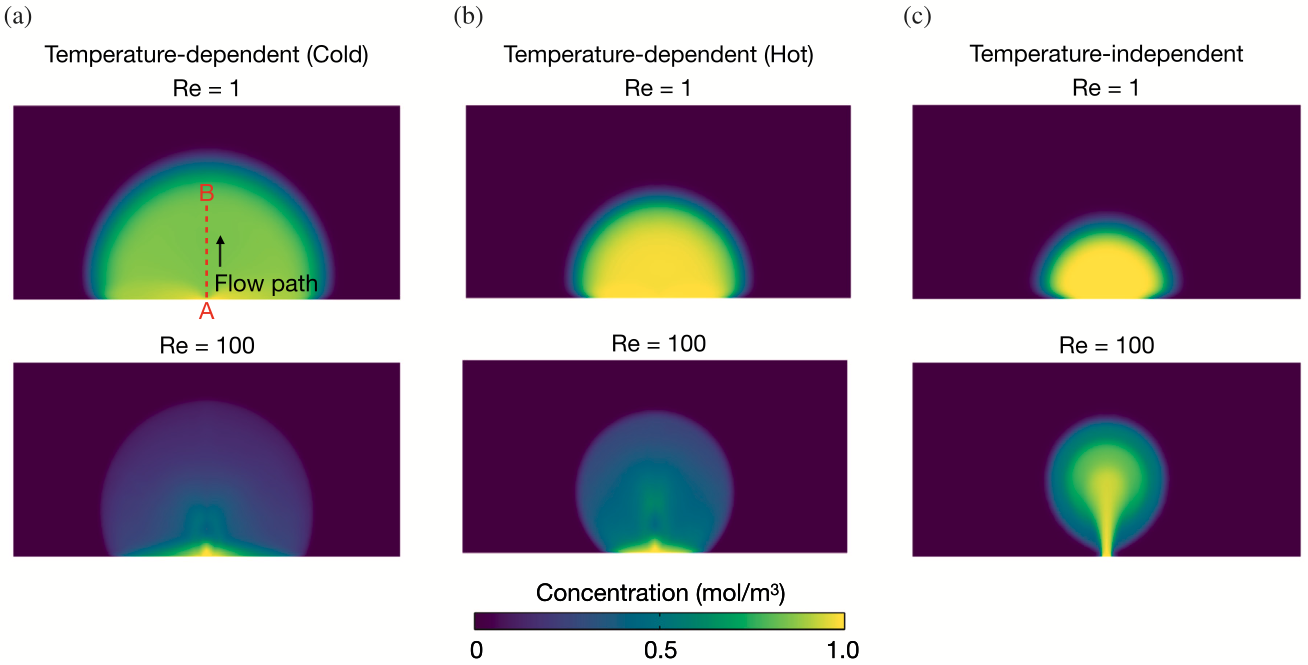
Temperature variations change fluid density and viscosity, which can substantially alter flow, solute transport, and heat transfer in rock fractures. Yet many non-isothermal fracture-flow models assume temperature-independent properties, leaving the roles of these property variations poorly constrained. Here, we investigate the roles of temperature-dependent density and viscosity in a smooth fracture using direct numerical simulations of cold- and hot-water injection at Reynolds numbers Re=1 and 100. Over the simulated 20–80 °C range, the density contrast is modest (Atwood number At≈0.013), whereas the viscosity contrast is much larger (about 65%). At Re=1, however, the small density contrast governs solute transport. Buoyancy-driven recirculation deforms solute plumes, enhances transverse mixing, accelerates breakthrough, and produces heavy late-time residence-time tails, whereas viscosity plays only a secondary role. At Re=100, inertia suppresses persistent buoyancy-driven recirculation, with the Richardson number decreasing from approximately 16,000 to 1.6, and the late-time residence-time tails decay much more steeply. Heat transport shows a different response: it is weakly sensitive to temperature-dependent properties at low Reynolds number, where conduction into the rock is important, but is strongly enhanced by advection at high Reynolds number. These results show that density and viscosity influence solute and heat transport through distinct mechanisms, and that density-driven buoyancy can be a primary control on solute mixing under buoyancy-dominated conditions even when the density contrast is modest.