New paper: GeoWarp: An automatically differentiable and GPU-accelerated implicit MPM framework for geomechanics based on NVIDIA Warp
Our paper, co-authored with Prof. Chenfanfu Jiang at UCLA, on an automatically differentiable and GPU-accelerated implicit MPM framework for geomechanics based on NVIDIA Warp has been published in Advances in Engineering Software.
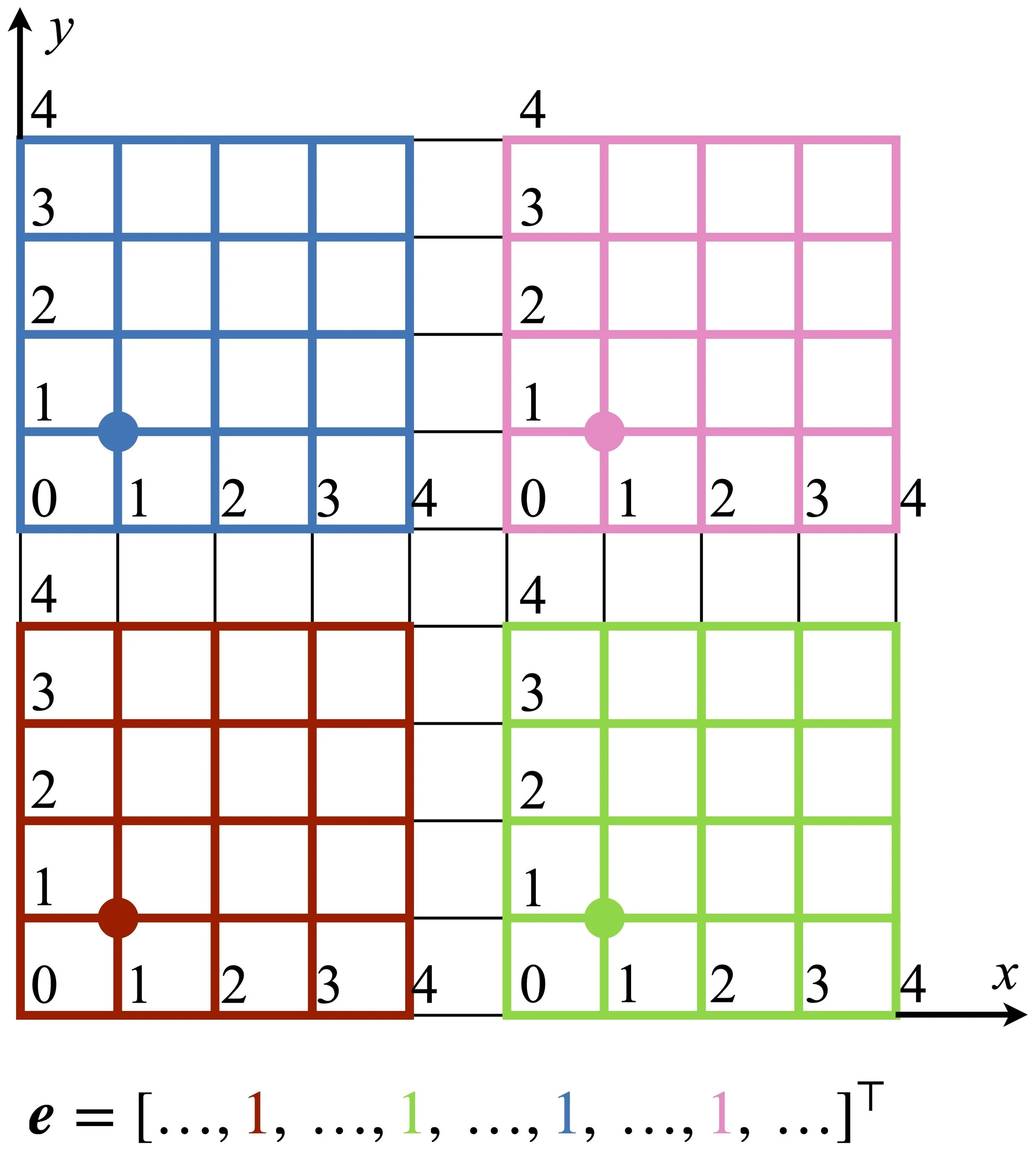
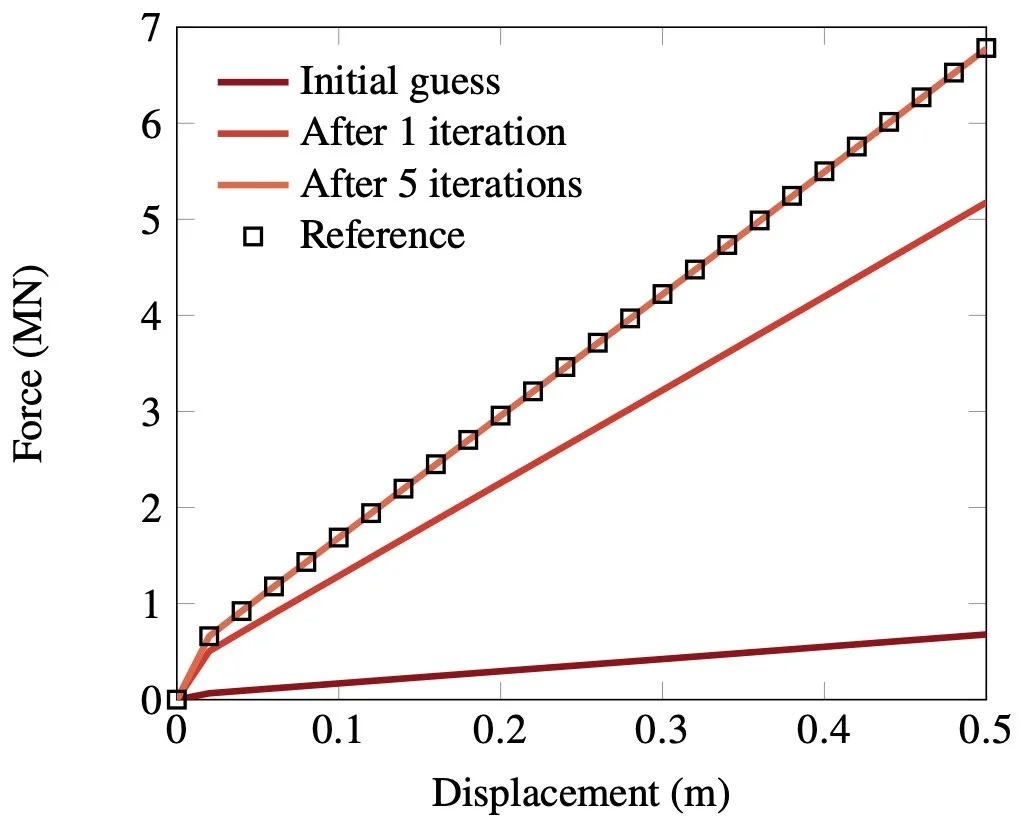
Abstract: The material point method (MPM), a hybrid Lagrangian–Eulerian particle method, is increasingly used to simulate large-deformation and history-dependent behavior of geomaterials. While explicit time integration dominates current MPM implementations due to its algorithmic simplicity, such schemes are unsuitable for quasi-static and long-term processes typical in geomechanics. Implicit MPM formulations are free of these limitations but remain less adopted, largely due to the difficulty of computing the Jacobian matrix required for Newton-type solvers, especially when consistent tangent operators should be derived for complex constitutive models. In this paper, we introduce GeoWarp—an implicit MPM framework for geomechanics built on NVIDIA Warp—that exploits GPU parallelism and reverse-mode automatic differentiation to compute Jacobians without manual derivation. To enhance efficiency, we develop a sparse Jacobian construction algorithm that leverages the localized particle–grid interactions intrinsic to MPM. The framework is verified through forward and inverse examples in large-deformation elastoplasticity and coupled poromechanics. Results demonstrate that GeoWarp provides a robust, scalable, and extensible platform for differentiable implicit MPM simulation in computational geomechanics.